AI Was Supposed to Replace Engineers. Instead, It Changed What Engineering Means.
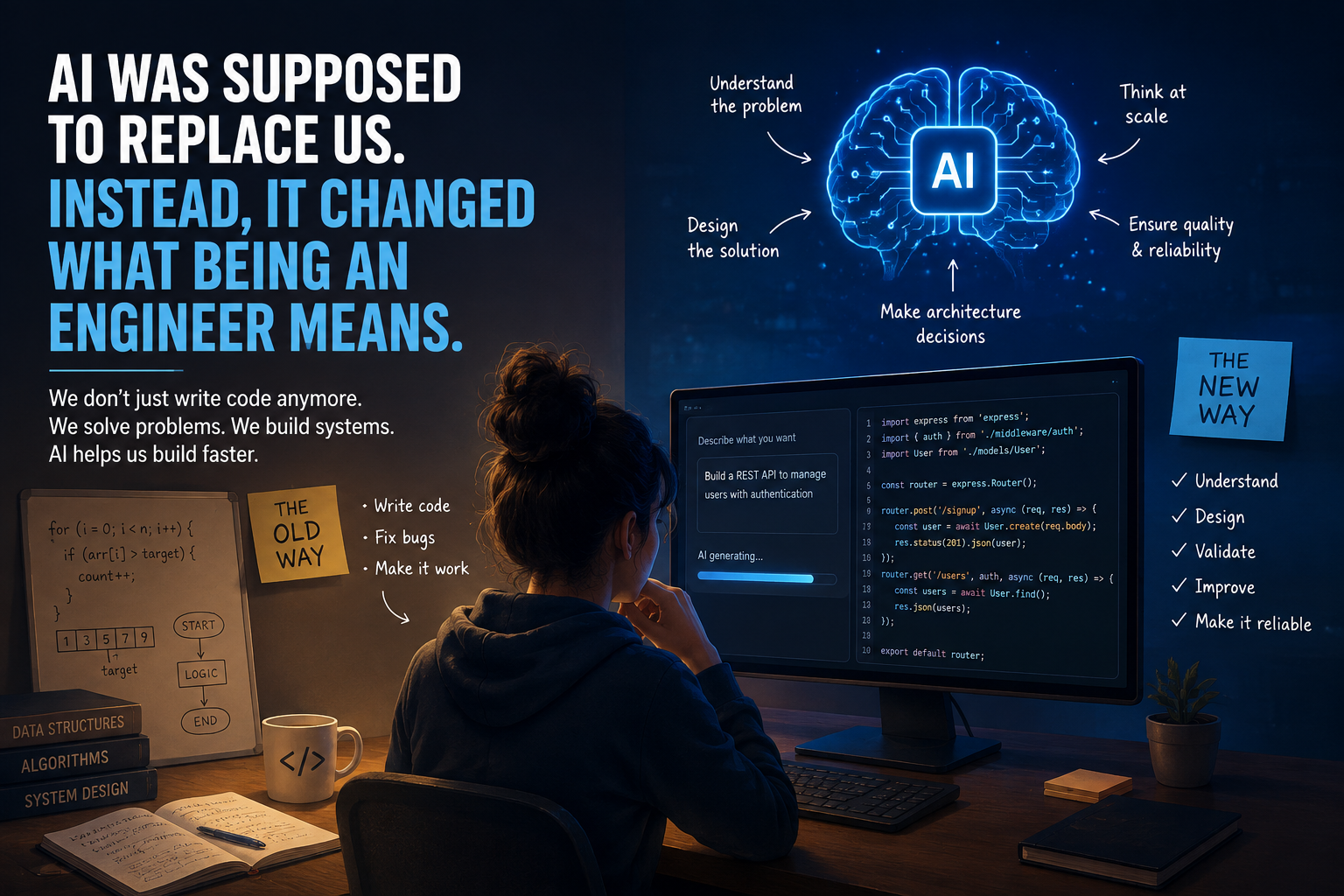
I still remember writing my first DSA algorithm completely from scratch.
I remember struggling with loops, logic, debugging, and finally seeing the code work.
Back then, writing the code was a big part of being an engineer.
Today, the dynamics are completely different.
I can honestly say there are times when I don't write a single line of code myself.
I describe what I want. AI writes the first version. Then my job becomes understanding it, reviewing it, debugging it, changing the architecture, and making sure it actually works.
And that made me realize something:
AI isn't simply replacing engineers. It's changing what we expect an engineer to do.
The mechanical part of programming is becoming cheaper.
But understanding a problem is not.
Knowing why something should be built, how it should work, what can go wrong, whether the architecture will scale, and whether the AI-generated code is actually correct — that still requires engineering judgment.
In fact, I think fundamentals are becoming more important, not less.
If you don't understand algorithms, systems, databases, APIs, architecture, and debugging, AI can make you productive very quickly — but it can also make you confidently wrong.
That's the interesting part.
I don't think the future belongs to engineers who write the most code.
I think it belongs to engineers who can say:
“I understand the problem. I know what needs to be built. Now let's use AI to build it.”
The engineer didn't disappear.
The engineer moved up a level.
And honestly, I'm excited to see where that goes.