How Coaching Centres Sell Fear — And Why It Reminds Me of Training an LLM
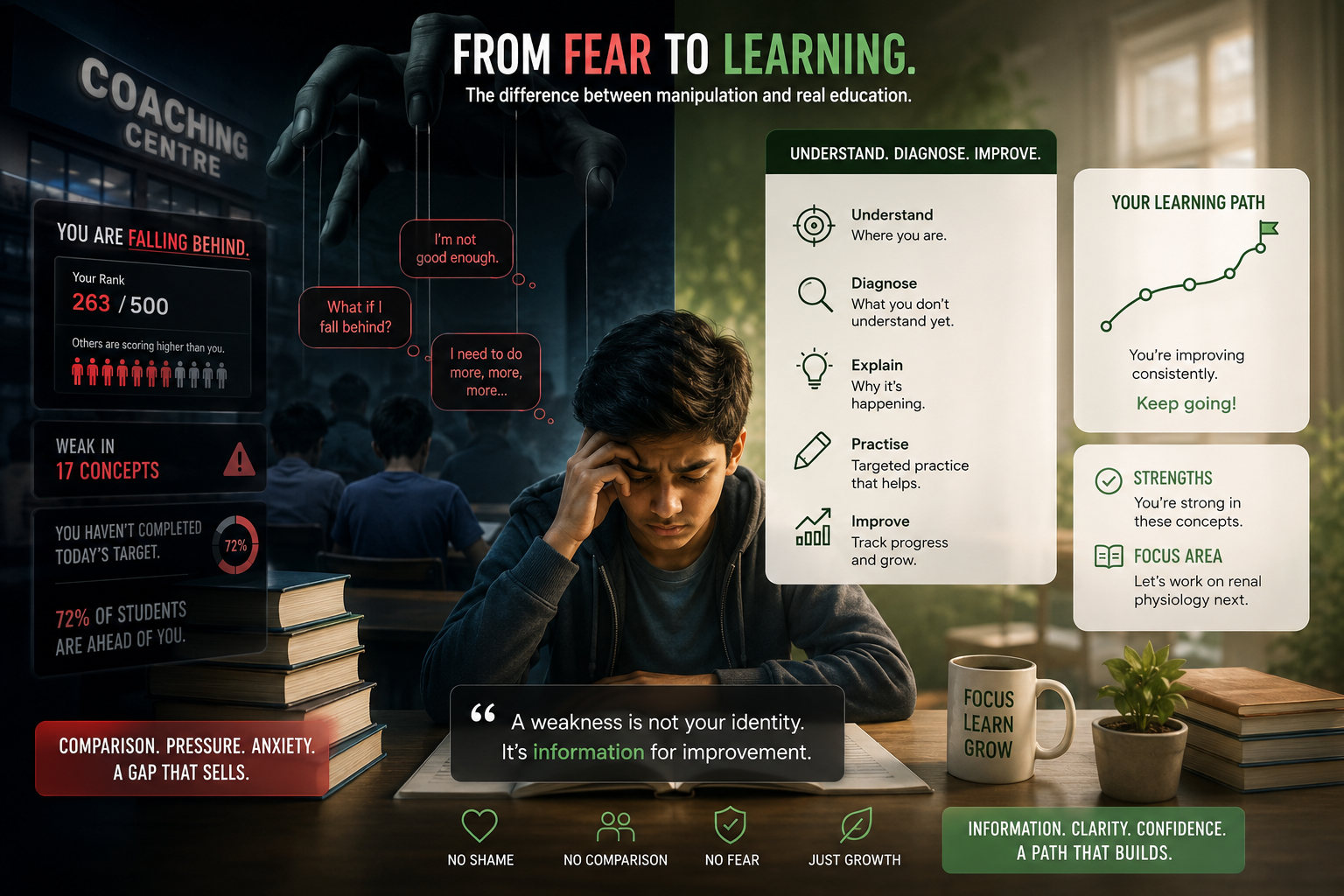
I still remember what happened after my 10th.
I had scored good marks.
Naturally, the next question was:
“Which coaching class should I join?”
Like many parents, mine weren't simply looking for tuition.
They wanted a better career, better opportunities, and some certainty about the future.
And that's where I noticed something that has stayed with me.
Many coaching centres don't start by telling parents how capable their child is.
They start by showing them where their child is falling behind.
Your child scored 90?
Someone else scored 95.
Your child is good at mathematics?
But can they solve this advanced problem?
Your child is already performing well?
Imagine how much better they could perform with us.
Slowly, something changes.
A student who was doing well starts feeling like they aren't doing enough.
A parent who was satisfied starts worrying.
First, they create the gap. Then they sell themselves as the solution.
“Don't worry. We can fix this.”
The Algorithm of Fear
If I had to reduce this process to an algorithm, it might look like this:
Student Performance
        ↓
Find a Weakness
        ↓
Compare With a Benchmark
        ↓
Highlight the Gap
        ↓
Make the Gap Feel Bigger
        ↓
Create Urgency
        ↓
Offer the Solution
        ↓
Enroll
And interestingly, this reminds me of something completely different:
training an LLM.
An LLM starts with a current state.
It makes a prediction.
The system measures the error.
That error becomes a signal.
The model updates itself.
Then it repeats.
Current State
      ↓
Prediction
      ↓
Measure Error
      ↓
Calculate Loss
      ↓
Update
      ↓
Repeat
The analogy isn't perfect. Students aren't neural networks, and learning isn't gradient descent.
But there is an important difference.
A healthy learning system uses error as information.
A manipulative system can use error as fear.
That's where things go wrong.
The Problem Isn't Comparison
Comparison itself isn't bad.
Knowing where you stand can help you understand what you need to improve.
For example:
“You understand this topic, but you're struggling with application-based questions.”
That's useful.
But the problem starts when comparison becomes the product.
Instead of asking:
“Is my child learning?”
the question becomes:
“Is my child ahead of everyone else?”
And there is always someone ahead.
Another student with higher marks.
Another rank.
Another exam.
Another chapter you haven't mastered.
Another test you haven't taken.
So there is always another reason to feel behind.
That's how education can turn into an anxiety market.
Technology Can Make This Even Worse
This is where educational technology needs to be careful.
An AI learning platform can know much more about a student's weaknesses than a traditional classroom.
It can know:
- which concepts they repeatedly get wrong,
- which questions take them too long,
- which chapters they avoid,
- where they lose marks,
- how their performance changes over time.
That's incredibly powerful.
But imagine using that information like this:
“You are weak in 17 concepts.”
Then:
“You're behind 72% of students.”
Then:
“You haven't completed today's target.”
Then:
“Your peers are studying more than you.”
Each feature might look harmless on its own.
Together, they can create something very different:
a system that constantly reminds students that they are not enough.
That's not adaptive learning.
That's anxiety with analytics.
The Difference Between Diagnosis and Manipulation
The same data can be used in two completely different ways.
A system can say:
“You are weak in renal physiology. Let's find the exact concept you're struggling with and practise it.”
Or it can say:
“Your renal physiology score is in the bottom 30%.”
The first gives you a path forward.
The second creates a status threat.
One tells you what to do next.
The other tells you how far behind you are.
That's a small difference in wording, but a huge difference in psychology.
The Learning System I Want to Build
This is something I've started thinking about deeply while building educational technology.
If we're going to use AI to understand a student's weaknesses, we shouldn't use those weaknesses to make the student feel smaller.
We should use them to help the student improve.
The system should be:
Understand → Diagnose → Explain → Practise → Improve.
Not:
Compare → Frighten → Pressure → Sell.
A weakness should be treated as information, not an identity.
A wrong answer shouldn't mean:
“I'm bad at this.”
It should mean:
“The system found something I need to work on.”
That's what good adaptive learning should do.
From Loss to Learning
Maybe that's the part of the LLM analogy I find most interesting.
In machine learning, loss isn't an insult.
It's a signal.
A higher loss doesn't mean the model is stupid.
It means:
there is more to learn.
Education should work the same way.
A student getting a question wrong shouldn't become a reason to make them feel smaller.
The mistake should simply tell the system:
“Here is where we need to teach differently.”
That's the kind of AI-powered education I want to build.
Not systems that manufacture insecurity.
Not endless rankings.
Not artificial urgency.
Not selling students the fear of being left behind.
But systems that can simply say:
“Here is where you are.”
“Here is what you don't understand yet.”
“Here is why.”
“And here is what you should do next.”
Because ultimately, the best learning system shouldn't convince a student that they are behind.
It should give them the clarity and confidence to move forward.