I Didn't Build an AI Tutor. I Built a Learning System.
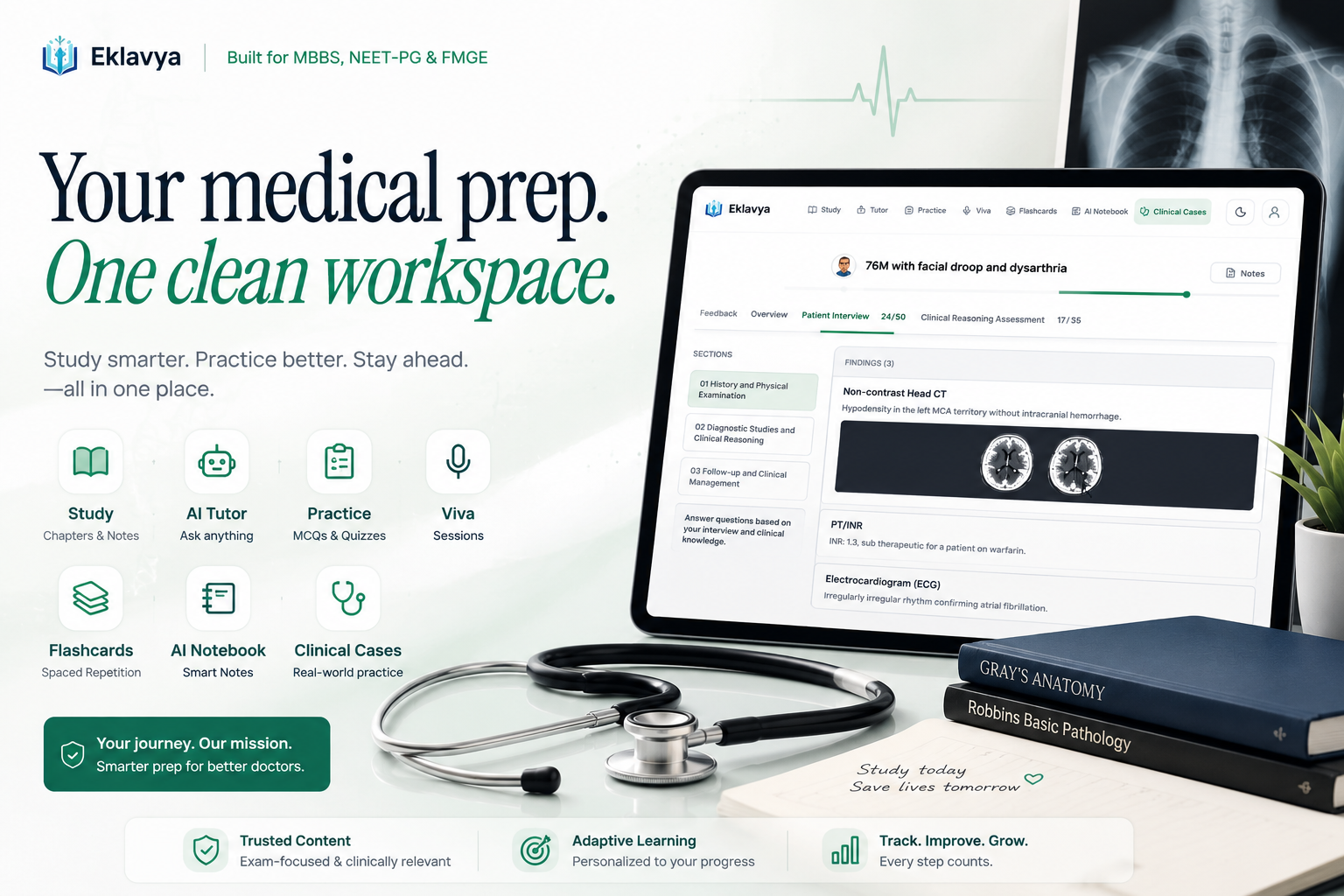
When I started building Medical.Eklavya, I had one goal:
Make learning adaptive without making the system unnecessarily complicated.
My first instinct was actually to avoid generating everything with AI.
Medical education is different. An AI-generated image can look convincing and still be inaccurate. So instead of asking, "How much can AI generate?", I started asking:
"How much can we understand, structure, and reuse correctly?"
That took me into data cleaning, content mapping, Hugging Face, medical study material, and eventually the harder engineering problem:
How do we decide what a student should learn next?
A student's journey isn't a fixed sequence.
They make mistakes.
They ask for help.
They struggle with concepts.
They forget things.
They improve.
So instead of treating every interaction as just another database entry, we started turning these behaviours into learning signals.
From there, the system can rank weak areas, prioritise what needs attention, generate daily learning plans, schedule revision, and adapt the next interaction.
Under the hood, it's not some magical neural recommender.
It's mostly deterministic engineering + adaptive rules, with LLMs supporting areas where language understanding and evaluation actually help.
We use weighted prioritisation for daily learning, state-based decision logic for viva, SM-2-like spaced repetition for flashcards, and state machines for clinical cases.
And I think that's where the interesting part begins.
Engineering is often about deciding what happens next.
A traditional algorithm asks:
Which node should I visit next?
A learning system asks:
Which concept should this student encounter next?
The difference is that the "node" is a human being with context, mistakes, uncertainty, and progress.
That's why I don't believe everything needs to be an AI model.
Sometimes the best engineering decision is knowing where not to use AI.
Our first version of Medical.Eklavya is now ready.
It's not perfect. It's not meant to be.
It's our first attempt at turning data, algorithms, learning science, and AI into something that feels less like a content platform and more like a learning system that listens to the student.
Now, I'd genuinely love constructive criticism.
Tell me where the learning logic can be better.
Tell me where the engineering is wrong.
Tell me what you would change.
Because we're not just building the system.
We're learning how to build it.