I Learned More From Things That Broke Than Things That Worked
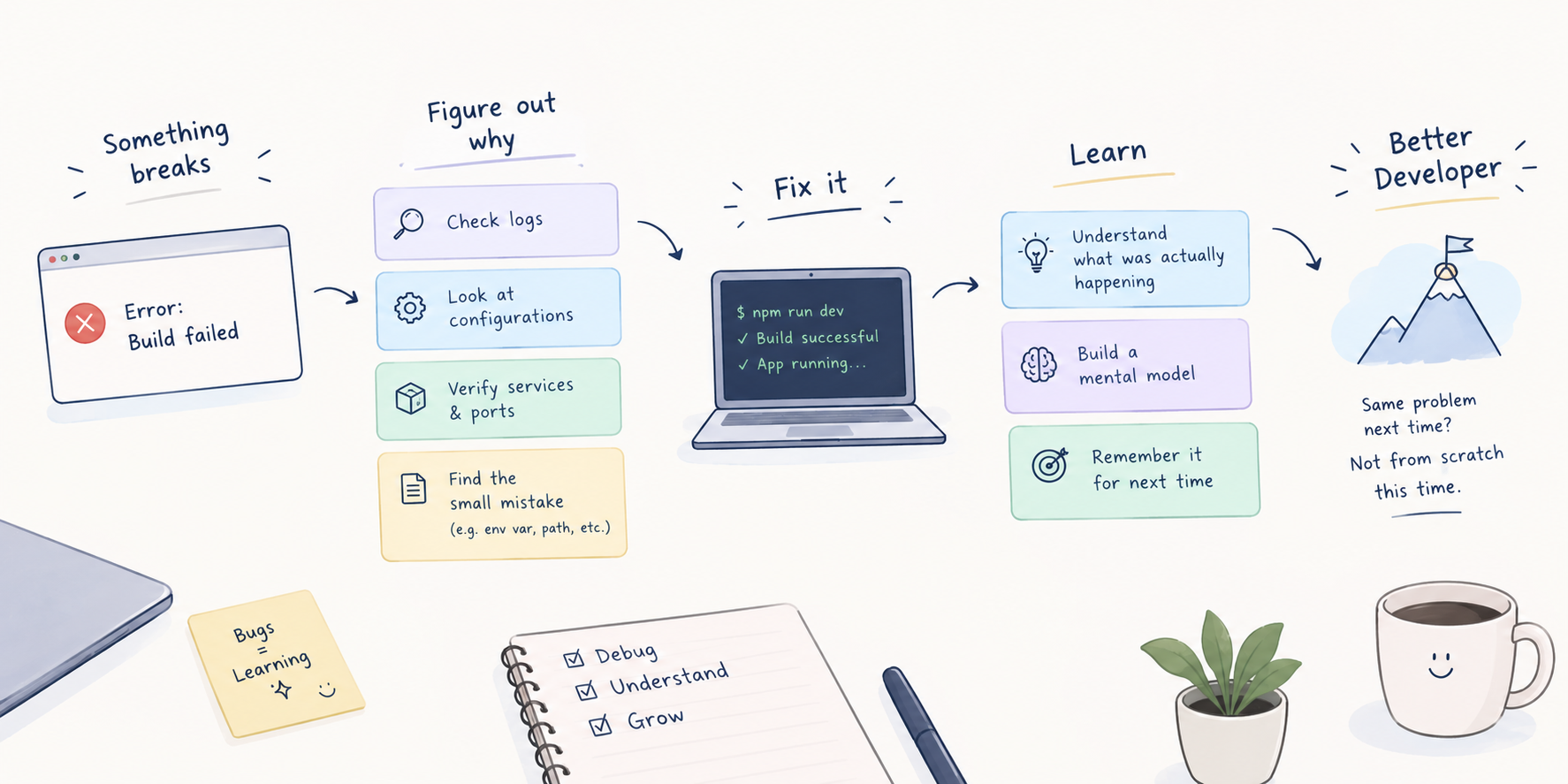
When something works, I usually don't think about it for very long.
I run the command, the app starts, the feature works, and I move on to the next thing.
But when something breaks, everything changes.
Suddenly, I have to understand why it broke.
And that's where I usually learn the most.
I've been learning more about development, AWS, DevOps, and just building things in general. One thing I've noticed is that the concepts I remember best aren't the ones I learned from tutorials.
They're the ones I had to figure out because something wasn't working.
A deployment that failed taught me more about deployment than a successful one.
A bug that took hours to find made me understand that part of the code much better.
An AWS configuration that didn't work made me actually understand what I was configuring instead of just following a tutorial.
And sometimes, the most frustrating part is realizing that the problem was something ridiculously small.
A missing environment variable.
A wrong port.
A service that wasn't running.
A configuration I assumed was correct.
Something that looked obvious only after I found it.
But maybe that's the point.
When everything works, I can get away with knowing what to do.
When something breaks, I have to understand why I'm doing it.
That's a completely different kind of learning.
The things that break stay with me
I probably won't remember every AWS command I've run.
I won't remember every bug I've fixed.
But I'll remember the moment when I spent an unreasonable amount of time trying to understand why something wasn't working.
Because after finally fixing it, I had a mental model for it.
The next time I saw something similar, I didn't need to search for the answer from scratch.
I had already been there.
And I think that's one of the underrated parts of becoming a better developer.
You don't just collect knowledge.
You collect experiences.
Some of them happen because you built something cool.
Others happen because you broke something you probably shouldn't have.
And honestly, I think I learn more from the second category.
So now, when something breaks, I'm still frustrated.
I still want to fix it as quickly as possible.
But I've started seeing those moments a little differently.
Maybe the broken thing isn't just an obstacle.
Maybe it's the part that's actually teaching me something.
Because sometimes, the bug is the lesson.