You Can Plan Your Next Year. Life Might Have Other Plans.
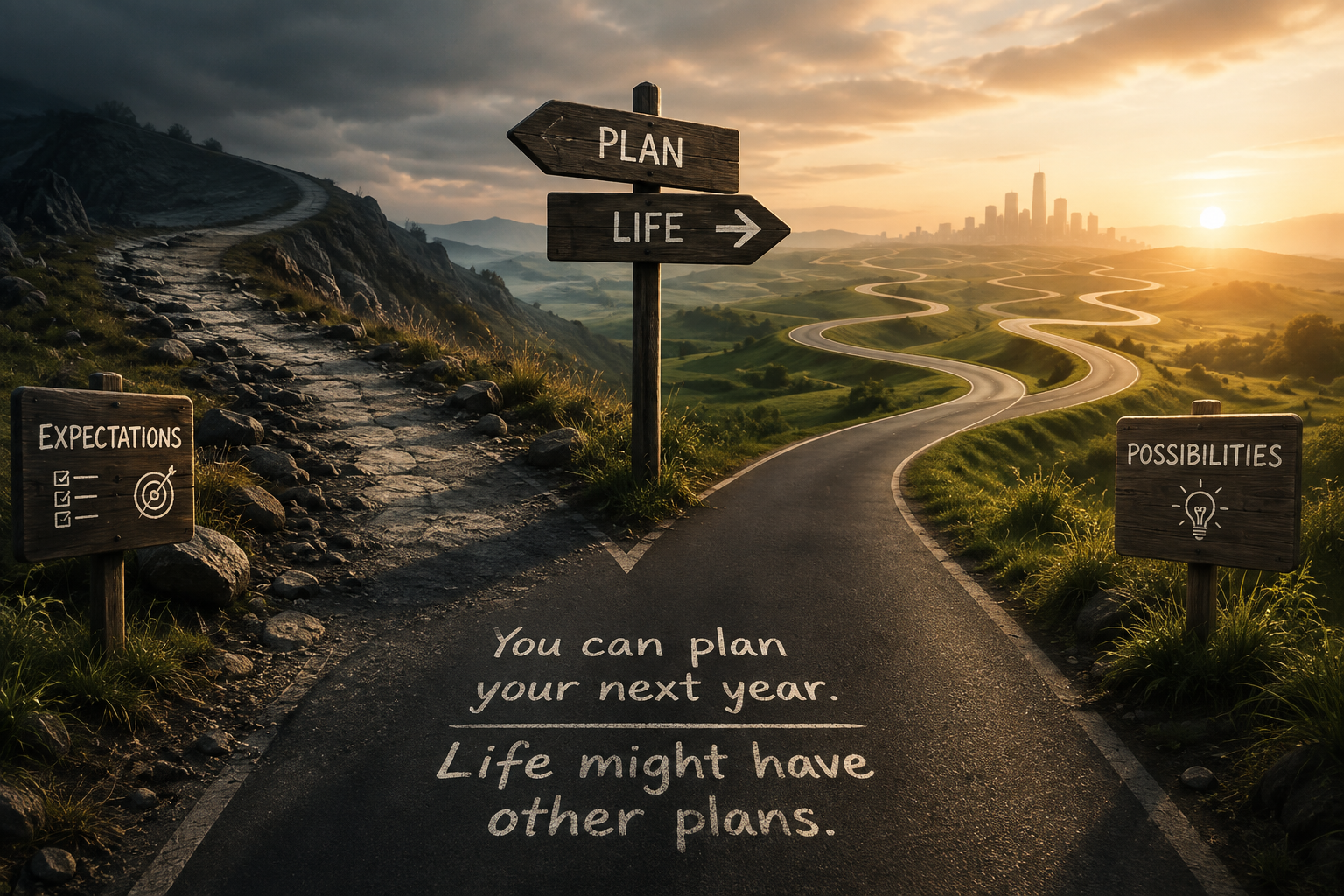
When I started engineering, I thought I had a pretty good idea of how the next four years would go.
Study.
Get internships.
Build projects.
Get a good job.
Graduate.
It sounded simple.
Like most students, I had a rough picture of where I wanted to be by the time engineering ended.
But looking back now, almost none of it happened exactly the way I imagined.
And maybe that's one of the most important things engineering taught me.
You can plan your future, but you can't plan how you'll get there.
I still remember my first paycheck.
It was ₹2,000.
I was in my second year of engineering, and getting an internship as a fresher wasn't easy. I wasn't the student who studied the most, and I definitely didn't have everything figured out.
But when I received that ₹2,000, I didn't think about how small the amount was.
I thought:
"Finally, I've started."
That was enough.
At the time, I had no idea where that first internship would lead.
I didn't know what opportunities would come next.
I didn't know which skills would become important.
I didn't know what kind of work I'd eventually be doing.
I was simply taking the next step.
And that step eventually led to another one.
And another.
A few years later, I found myself paying my final-year engineering fees, running into lakhs, from what I had earned during my second and third years.
If someone had shown me that picture when I was earning my first ₹2,000, I probably wouldn't have believed them.
The distance between those two moments was created one small decision at a time.
We are constantly planning a future that doesn't exist yet.
There's something funny about being an engineering student.
We are always thinking about the next milestone.
"Next month I'll learn this."
"Next semester I'll build that."
"After this internship, I'll do this."
"By the end of the year, I'll be here."
I've done it too.
We make plans for the next month, the next semester, the next year.
And then life happens.
An unexpected opportunity appears.
A plan doesn't work.
Someone introduces you to something completely different.
You discover that you enjoy something you never considered before.
You stop doing something you were certain you'd continue.
Suddenly, the plan you made three months ago doesn't make sense anymore.
And you have to make a new one.
I used to think changing plans meant I wasn't being consistent.
Now I think it means I'm paying attention.
Because how can you make a perfect plan for a future you haven't experienced yet?
You can't.
You can only make the best decision with the information you have today.
Engineering teaches you this in a strange way.
You start with a problem.
You make an approach.
You write some code.
It doesn't work.
You debug it.
You try another approach.
Maybe you realise your original idea was wrong.
So you change it.
Sometimes you throw away hours of work because you discover a much simpler solution.
And eventually, you learn something important:
The goal was never to follow the original plan perfectly.
The goal was to reach the right outcome.
I think life works the same way.
We sometimes become too attached to the path we've imagined.
But the path is not the destination.
If something changes, you don't necessarily have to give up.
Sometimes you just need to adjust.
The most drastic changes often don't feel drastic while they're happening.
When you're living through them, most changes feel small.
One internship.
One project.
One person you meet.
One decision to try something new.
One opportunity you almost didn't take.
One rejection that forces you to try something else.
None of these moments necessarily feel life-changing at the time.
But years later, when you look back, you realise they completely changed your direction.
That's what surprises me the most.
We often understand the importance of a moment only after it has passed.
My ₹2,000 paycheck didn't feel like the beginning of a story.
It just felt like a first salary.
But looking back, it was a beginning.
So I've stopped trying to predict everything.
I still make plans.
I still think about what I want to achieve next month and next year.
I still set goals.
But I've become much more comfortable knowing that those plans might change.
Maybe I'll discover something better.
Maybe something won't work.
Maybe an opportunity will take me somewhere I didn't expect.
Maybe I'll have to start again.
That's okay.
I don't think the goal is to have your entire life figured out at 21 or 22.
The goal is to become someone who can handle whatever comes next.
Someone who can learn.
Adapt.
Start again.
Keep moving.
Looking back at my engineering journey, the biggest lesson wasn't a particular programming language, framework, or project.
It was learning that progress rarely happens according to plan.
Sometimes the opportunity you wanted doesn't come.
Sometimes an unexpected one does.
Sometimes the thing you thought would take a year happens in a month.
Sometimes something you planned for months disappears overnight.
And sometimes a ₹2,000 beginning eventually takes you somewhere you never imagined.
So make the plan.
Set the goal.
Think about the future.
But don't be afraid when the plan changes.
Because it probably will.
And maybe that's not a failure of the plan.
Maybe that's just how life works.
You don't need to know exactly where you'll be five years from now.
You just need to make the next good decision.
Then another.
Then another.
And one day, you might look back and realise that all those small, unplanned turns brought you somewhere much better than the place you originally planned to go.